
ChatGPT Ads for Hotels: From AI Discovery to Direct Bookings ( Updated)
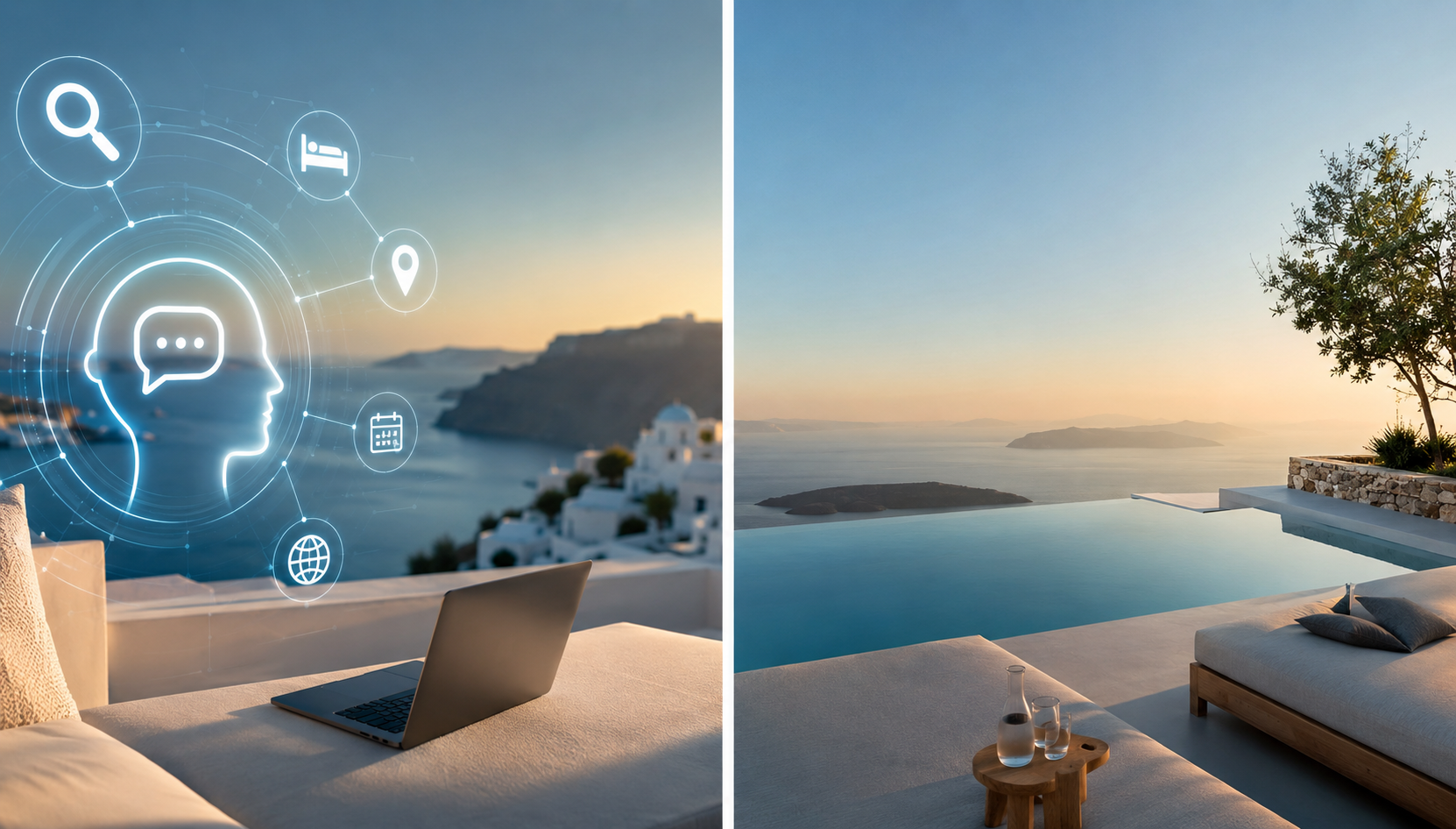
How AI advertising, GEO and a connected hospitality digital marketing strategy can help hotels become discoverable earlier — and turn that visibility into more direct revenue.
The way travellers discover hotels is entering a new phase.
For years, hotel acquisition has been built around a familiar ecosystem: Google Search, social media, metasearch platforms and Online Travel Agencies (OTAs).
These channels remain essential. But travellers are increasingly adding another behaviour to the journey:
they are asking AI.
Instead of searching only for “luxury hotel Santorini”, a traveller can now describe the experience they actually want:
“Find me a romantic boutique hotel in Santorini with a private pool and sunset views.”
“Where should I stay in Greece for a quiet luxury weekend with great food?”
“Recommend design-led hotels in Thessaloniki within walking distance of restaurants and nightlife.”
This represents an important shift for hospitality marketing.
Search has traditionally been about being visible when someone enters the right keywords.
AI discovery is increasingly about being relevant when someone expresses the right intent.
And as advertising begins to enter conversational AI environments such as ChatGPT, a new hospitality acquisition opportunity is emerging.
But the opportunity is bigger than ChatGPT Ads.
It is about connecting:
AI Discovery → Hotel Visibility → Qualified Visit → Digital Experience → Direct Booking → First-Party Guest Relationship
At Brand Atelier, we call this the AI-to-Direct Booking Framework.
From Search Intent to Traveller Intent
Traditional hotel search often starts with a destination and a category.
Boutique hotel Athens.
Luxury hotel Mykonos.
Santorini hotel private pool.
Conversational AI allows travellers to communicate much richer intent.
They can describe the occasion, budget, preferred atmosphere, location, amenities and type of experience they want within a single conversation.
That distinction matters.
A traveller asking:
“Where should I stay in Mykonos?”
is exploring.
Someone asking:
“Find me a quiet boutique hotel in Mykonos with sea views, a pool and good restaurants nearby”
is revealing considerably more about what could influence the booking decision.
For independent and boutique hotels, this creates an interesting opportunity.
A property may not have the advertising budget or domain authority of an international hotel group or major OTA.
But it may have exactly the experience the traveller is describing.
The challenge is making sure digital and AI systems can understand that.
What Could ChatGPT Ads Mean for Hotels?
ChatGPT Ads introduce advertising opportunities within conversational AI environments.
For hospitality marketers, their significance is not simply that another advertising placement exists.
The interesting element is the context and intent surrounding the traveller.
Someone researching Greek islands for an anniversary is already signalling travel intent.
Someone comparing destinations with boutique hotels, private pools and gastronomy experiences is providing even more context.
And someone researching specific accommodation characteristics, locations and price ranges may already be approaching the consideration stage.
For hotels, conversational advertising could therefore become another route between traveller intent and the hotel's own digital ecosystem.
However, there is an important distinction:
Buying an AI ad is not a direct booking strategy.
It is an acquisition opportunity.
What happens after the click — or interaction — determines its commercial value.

The Brand Atelier AI-to-Direct Booking Framework
At Brand Atelier, we believe AI should not be treated as an isolated marketing channel.
For hospitality brands, its value becomes more meaningful when it connects discovery with measurable commercial outcomes.
Our framework considers six connected stages:
1. AI Discovery
A traveller uses conversational AI to research a destination, experience or accommodation requirement.
2. Hotel Visibility
The property becomes discoverable through organic AI visibility, relevant content, search visibility or emerging paid AI placements.
3. Qualified Visit
The traveller moves from discovery into the hotel's owned digital environment.
4. Digital Experience
The website communicates the hotel's positioning, atmosphere, rooms, experiences and reasons to choose the property.
5. Direct Booking
The digital journey reduces friction between inspiration and reservation.
6. First-Party Guest Relationship
The hotel develops a direct relationship with the guest rather than relying exclusively on an intermediary.
The commercial objective is therefore not simply:
“How do we advertise on AI?”
It is:
“How do we turn AI-driven discovery into profitable direct demand?”
Why Direct Booking Economics Matter
OTAs remain important distribution partners.
For many hotels, they provide reach, international demand, convenience and valuable visibility.
The strategic objective should therefore not automatically be to eliminate OTAs.
It should be to create a healthier distribution mix.
Consider two bookings generating the same room revenue.
One arrives through an intermediary and carries an acquisition or commission cost.
The other arrives through the hotel's own digital ecosystem and carries a different acquisition cost structure.
The revenue may look identical at the top line.
The economics underneath it are not necessarily the same.
This is why hospitality marketing should increasingly evaluate metrics such as:
direct booking revenue
OTA versus direct channel mix
acquisition cost by channel
OTA commission expenditure
website conversion rate
average booking value
length of stay
upsell revenue
repeat guest value
revenue by source market
A gradual improvement in direct-booking contribution can therefore become commercially meaningful without requiring a hotel to abandon OTA distribution.
The objective is not OTA elimination. It is stronger control over demand.
GEO: Preparing Hotels for AI Discovery
Paid advertising represents only one side of the AI opportunity.
The other is organic AI discoverability.
This is where Generative Engine Optimization — GEO — becomes increasingly relevant.
Traditional SEO focuses on making webpages accessible, understandable and relevant within search engines.
GEO expands the conversation toward how clearly AI-powered discovery systems can understand a hotel's identity, location, services, experiences and relevance to a traveller's question.
For a hotel, this means creating a digital presence that clearly communicates:
property type and positioning
destination and precise location context
room and suite categories
amenities
architecture and interior design
gastronomy
wellness
beach or pool experiences
weddings and events
nearby attractions
local experiences
seasonal travel information
ideal guest profiles and occasions
direct booking advantages
The objective is not to produce artificial copy written for machines.
It is to build a clear, authoritative digital representation of the property that both travellers and intelligent systems can understand.
SEO and GEO Should Work Together
AI discovery does not make traditional SEO irrelevant.
In fact, many of the foundations remain connected.
Strong website architecture, useful content, crawlability, structured information, clear entities and genuine expertise help create a stronger digital presence.
The difference is that hospitality content can increasingly be designed around questions and decisions, not only keywords.
Instead of creating another generic page targeting:
“Luxury Hotel Greece”
a hotel can develop useful content around questions travellers actually have:
Where should couples stay in Santorini?
Which areas of Athens are best for a luxury weekend?
When is the best time to visit Halkidiki?
Which rooms are best for families?
What can guests experience around the hotel without renting a car?
This content does more than target long-tail searches.
It creates context around the property.
The Hotel Website Becomes More Important Not Less
AI may change how a traveller discovers a property.
It does not remove the need to persuade them.
Once someone reaches the hotel's website, several questions need to be answered quickly:
Why this hotel?
Why this location?
Why this room?
What makes the experience distinctive?
Can I trust this property?
Why should I book directly?
This is where hotel website strategy, editorial design and conversion thinking become critical.
Beautiful photography without positioning is not enough.
Traffic without conversion is not enough.
SEO rankings without qualified demand are not enough.
And AI visibility without a strong destination for that traffic is not enough.
The website should function as the hotel's owned digital sales environment.
From Traffic Metrics to Hospitality Decision Intelligence
One of the biggest changes AI can bring to hospitality marketing may ultimately happen behind the scenes.
Hotels already generate significant amounts of data through:
PMS systems
booking engines
Google Analytics
advertising platforms
CRM systems
OTA reports
email marketing
revenue management systems
guest behaviour
The challenge is rarely the complete absence of data.
The challenge is turning it into better decisions.
Instead of asking only:
How many people visited our website?
a commercially focused hospitality strategy should ask:
Which markets generate the most profitable guests?
Which campaigns contribute to direct bookings?
Where are travellers abandoning the booking journey?
How much are we paying to acquire revenue through each channel?
Which room categories perform best by source market?
Which guest segments create additional F&B or experience revenue?
This moves digital marketing beyond reporting.
It moves it toward decision intelligence.
How Brand Atelier Integrates AI Into Hospitality Digital Marketing
At Brand Atelier, we approach Hospitality Digital Marketing Management as an interconnected commercial ecosystem.
The objective is not to manage SEO, advertising, content and AI as separate activities.
They should reinforce one another.
SEO & Search Strategy
Building sustainable visibility around destination, accommodation and high-intent travel searches.
GEO & AI Visibility
Creating clearer entities, content structures and digital signals designed for an increasingly AI-assisted discovery environment.
Paid Media & Emerging AI Advertising
Connecting established acquisition platforms with emerging opportunities such as conversational advertising, according to commercial objectives and traveller intent.
Hospitality Content Strategy
Transforming architecture, gastronomy, destination knowledge, design and guest experiences into useful, searchable and AI-discoverable digital assets.
Website & Conversion Experience
Creating an editorial digital experience that moves the traveller from inspiration toward consideration and booking.
Direct Booking Strategy
Evaluating marketing activity according to its contribution to direct demand, acquisition economics and the wider distribution mix.
Data & Decision Intelligence
Connecting marketing performance with commercial indicators to help hospitality businesses make better decisions about markets, audiences, channels and investment.
The result is not another collection of digital marketing services.
It is a connected system designed around one question:
How can digital discovery create more valuable guest relationships?
When Will ChatGPT Ads Be Available in Europe and Greece?
ChatGPT officially launched in Europe and in Greece.
For hotels and hospitality businesses in Greece, this should therefore be viewed as an emerging acquisition opportunity.
But also hotels can also prepare
SEO, GEO, structured content, strong hotel positioning, first-party data and an effective direct booking journey can all be developed today.
Last updated: September 2026.
AI Will Not Replace Google, Social Media or OTAs
The future travel journey will probably not belong to one platform.
A traveller might discover a destination through Instagram.
Ask ChatGPT to help narrow down where to stay.
Use Google to research the properties.
Check reviews and OTA pricing.
Visit the hotel's website.
And finally book directly.
The opportunity for hotels is therefore not to predict which single platform will “win”.
It is to build a digital ecosystem capable of remaining relevant throughout the decision journey.
That requires a combination of visibility, content, technology, brand experience and commercial intelligence.
Frequently Asked Questions
What are ChatGPT Ads for hotels?
ChatGPT Ads represent an emerging advertising opportunity within AI-powered conversations. For hotels, they can create another way to reach travellers while they are researching destinations, accommodation options and specific travel experiences. They should be considered part of a broader hospitality acquisition strategy rather than a standalone solution.
Can ChatGPT Ads generate direct bookings for hotels?
Potentially. Conversational advertising can introduce relevant travellers to a hotel's owned digital environment during discovery or consideration. Whether that interaction becomes a direct booking depends on the complete journey, including targeting, positioning, website experience, room presentation, booking proposition and booking engine.
What is GEO for hotels?
Generative Engine Optimization (GEO) focuses on making a hotel's identity, location, accommodation, services, experiences and expertise clearer within AI-powered discovery environments. It can involve content architecture, entity clarity, structured information, destination expertise and authoritative answers to traveller questions.
What is the difference between hotel SEO and GEO?
Hotel SEO focuses primarily on improving discoverability within traditional search engines. GEO focuses on how brands and information can be understood and surfaced within generative and conversational AI environments. The two should work together as part of a broader hotel digital visibility strategy.
Will AI search replace Google and OTAs?
AI should currently be considered an additional discovery environment rather than a replacement for Google, social media or OTAs. Travellers can move between several platforms before making a booking decision, which makes a diversified and connected digital presence increasingly important.
How can an independent hotel prepare for AI-driven travel search?
Start with the fundamentals: clear positioning, strong website architecture, useful destination and experience content, structured information, SEO, AI discoverability and an effective direct booking journey. These foundations remain valuable regardless of which individual AI platforms become dominant.
How can hotels reduce OTA dependency?
The objective does not necessarily need to be eliminating OTAs. Hotels can develop a healthier distribution mix by strengthening organic demand, paid acquisition, brand awareness, AI discoverability, first-party relationships, remarketing and their direct booking experience.
Does a hotel need a new website for GEO?
Not necessarily. The first step should be evaluating whether the existing website clearly communicates the hotel's identity, location, accommodation and experiences and whether its architecture supports search and AI discovery. Some properties may require optimization, while others may benefit from a more substantial digital redesign.
How should hotels measure digital marketing performance?
Hotels should look beyond traffic and impressions. Relevant metrics include direct booking revenue, conversion rate, customer acquisition cost, OTA commission costs, direct-to-OTA channel mix, average booking value, source-market performance and revenue generated through different acquisition channels.
When will ChatGPT Ads be available for hotels in Greece?
OpenAI is progressively expanding ChatGPT advertising internationally and across Europe during 2026. Availability and advertiser access can vary as the rollout develops. Hotels in Greece should verify current availability through official OpenAI information while preparing their SEO, GEO, content and direct booking infrastructure for AI-driven travel discovery.
How does Brand Atelier integrate AI into hospitality digital marketing?
Brand Atelier combines hospitality strategy, SEO, GEO, AI visibility, content, paid media, website conversion and decision intelligence into a connected digital marketing approach.
Emerging channels such as conversational AI advertising are evaluated alongside established acquisition channels rather than treated as isolated tactics.
The objective is to help hospitality brands become easier to discover, understand, choose and book.
From AI Discovery to Direct Revenue
The next evolution of hospitality marketing is not simply about placing advertisements inside AI.
It is about connecting the entire commercial journey:
Discovery → Visibility → Experience → Booking → Data → Better Decisions
Hotels that build those connections can become less dependent on any single acquisition platform and develop stronger control over their digital demand.
Brand Atelier Hospitality Digital Marketing Management brings together SEO, GEO, AI visibility, content, paid acquisition, digital experience and direct booking strategy within one connected hospitality approach.
